
Prototype reliability
Agent loops, brittle retrieval, non-deterministic tool calls, weak structured outputs, and missing failure recovery.
DeepVention engineers agent integrations, multi-agent orchestration, secure MCP infrastructure, evaluations, guardrails, and AgentOps for regulated SaaS, healthtech, fintech, and enterprise AI teams.
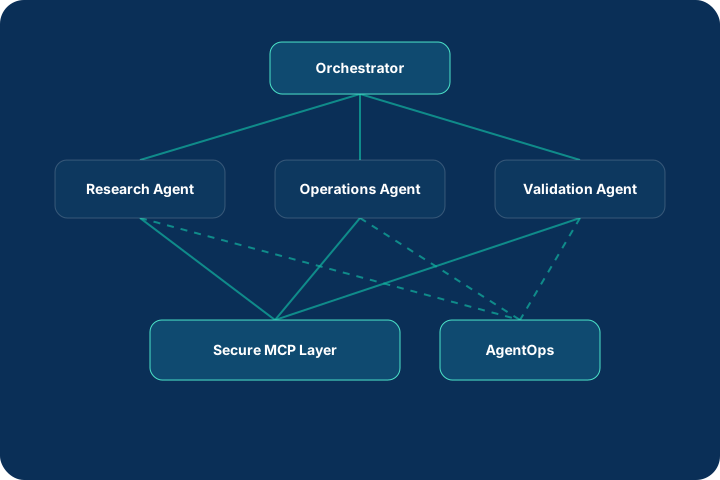
The hard engineering starts when agents meet real users, enterprise systems, permissions, sensitive data, and production reliability requirements.
Agent loops, brittle retrieval, non-deterministic tool calls, weak structured outputs, and missing failure recovery.
Identity, APIs, internal data, permissions, tenant boundaries, and secure access to business systems.
Missing traces, weak test datasets, no regression gates, and unclear cost, latency, or agent quality.
Prompt injection, sensitive-data exposure, over-permissioned tools, weak auditability, and missing human controls.
We help software and AI teams integrate, orchestrate, secure, evaluate, and operate agentic systems in production.

Connect agents to your product, knowledge, APIs, and operational systems with controlled tool access, retrieval, structured outputs, evaluations, and telemetry.
ProductionEngineering
Design supervisor, routing, handoff, state, approval, retry, and failure-recovery patterns for workflows that need more than one reasoning component.
ProductionEngineering
Build MCP servers and gateway layers with identity, authorization, tenant isolation, tool allowlists, rate limits, secrets handling, and audit logs.
ProductionEngineering
Trace agent behavior, measure quality, cost, latency, tool failures, and release regressions so production decisions are based on evidence.
ProductionEngineering
Implement prompt-injection defenses, validation, redaction, tool authorization, human approval, policy controls, auditability, and kill switches.
ProductionEngineering
Engineer AI-assisted workflows around APIs, documents, CRM/ERP systems, approvals, schedules, and event-driven operations.
ProductionEngineeringA structured engineering path for teams that need confidence before scaling autonomous behavior.
Map the workflow, data, integrations, permissions, failure modes, and production constraints.
Validate the highest-risk technical assumptions with a focused implementation and measurable acceptance criteria.
Build the runtime, integrations, state, tool boundaries, deployment, and operator experience.
Add regression datasets, traces, policy checks, adversarial cases, approval gates, and release criteria.
Operate and improve the system through telemetry, evaluations, incident learning, and controlled releases.

Agentic features that must respect tenant boundaries, permissions, auditability, and existing product architecture.

AI workflows designed around sensitive data, human oversight, traceability, and security-conscious integration.

Tool-using agents and workflows with strict authorization, review points, logging, and controlled system access.

Shared agent infrastructure, gateways, evaluations, observability, and reusable tool interfaces across teams.

Production hardening for products where agents, retrieval, and tool use are part of the core user experience.
We select tools around system requirements rather than forcing every project into one agent framework.
LangGraph, OpenAI Agents SDK, CrewAI, AutoGen, structured tool calling, state machines, approval flows.
Python, FastAPI, TypeScript, Node.js, PostgreSQL, Redis, Docker, Kubernetes, AWS, Azure, GCP.
OAuth/OIDC, authorization policies, API gateways, OpenTelemetry, LangSmith, Langfuse, Traceloop, customer-approved stacks.
Explore illustrative product surfaces shaped around agents, integrations, retrieval, workflow automation, and the controls required for reliable operation.
A reference architecture for a secure agent gateway with allowlisted tools, approval checkpoints, traces, and regression datasets.
We publish technical notes on AI agents, agentic applications, workflow automation, RAG, product engineering, evaluation, and production operations.
AI coding tools can turn an idea into a working demo quickly. Here is a practical code audit and refactoring path for making that…
Aug 26, 2026
Scaling an AI-native application is a product and systems problem, not simply a larger server. This guide covers data design, APIs, background work, caching,…
Aug 26, 2026
A production AI agent needs more than a capable model. It needs permission-aware retrieval, explicit tools, bounded autonomy, and a human approval path for…
Aug 26, 2026
Engineering · Local demo – replace before launch
Help design agent runtimes, secure tool infrastructure, evaluation loops, and observability for production-minded AI systems.
Replace before launch
Talk through your architecture, integration constraints, security boundaries, evaluation strategy, or reliability problems with DeepVention.
Tell us what you are building, where it needs to operate, and what constraints matter. We will come back with a focused next step.